
Blog & Resources/

The Quarter for Finishing: Why Strategic Progress Sometimes Means Doing Less
At the beginning of October, I declared the final three months of 2026 my quarter for finishing. FINISH & FREE UP! There was something rather satisfying about the idea of reaching the end of the year having completed the things that had been occupying my time, energy and attention, particularly those that would help create more freedom in 2027.
Of course, there’s still business as usual (BAU). There are clients to support, businesses to run, families to look after, meals to cook and all the everyday responsibilities that come with life. Those things continue regardless of our ambitions, although alongside BAU we have our strategic priorities, the commitments we make because they move us towards something bigger.
I’ve been wondering whether sometimes the most valuable strategic decision we can make is to finish what we’ve already started, rather than continually adding more to an already substantial list.
Aligning our goals with our purpose
Every year, just as I do with my clients, I set personal and professional goals. My business goals relate to the work I do, my development, my clients and the contribution I want to make. My personal goals are connected to what I call Operation Freedom, creating the financial independence, time and flexibility to live life on my terms. These goals are interconnected because the business I build needs to support the life I want to live. This approach to strategic planning and goal setting has been part of my life for more than thirty years, and it continues to shape how I approach business strategy, leadership development and personal growth. As I approached October, I asked myself what I could finish during the final quarter that would create greater capacity and choice next year. The answer was a fairly substantial collection of commitments, each connected to my longer-term purpose and strategy.
My quarter for finishing
I’m working towards completing the audiobooks for Behind the Coaching Breakthroughs and True to Your Word, alongside the PROMISE Framework™ resources. I’m also finishing version 3.0 of my Two Tides website and several AI builds designed to improve the efficiency and effectiveness of my work with clients. Another important commitment is progressing the first ANZCAL Insight research survey, part of my contribution to the coaching profession and the legacy I want to build. Alongside this, I’m catching up on professional reading, Outthinker learning and the daily revision that supports my NLP Master Trainer development. On the personal side, there’s my gym challenge, supporting my daughter as she prepares for her move to Wānaka, and helping my son prepare for life in Brisbane. Each commitment connects to something bigger, whether that’s mastery, contribution, wellbeing, family or freedom. The objective is to complete these things because of what their completion makes possible, creating more time, energy and capacity for the opportunities and experiences I want to pursue next.
The leadership mindset required to finish
Finishing requires a particular mindset, especially when you’re someone who enjoys new ideas, opportunities and challenges. It means staying focused when something more exciting appears and recognising that every additional commitment demands time, attention, and energy. I’ve declined additional mentoring requests, award judging opportunities and invitations to join groups that I would ordinarily enjoy. I’ve also protected my Fridays to concentrate on work that supports my longer-term goals, recognising that worthwhile opportunities can still be poorly timed.
Michael Porter explored this principle in his Harvard Business Review article, What Is Strategy?, highlighting the importance of strategic trade-offs and making deliberate choices about what an organisation will pursue.
It’s a principle I regularly explore through executive coaching, because effective leadership requires us to make intentional decisions about where our resources and attention will create the greatest value. A clear business strategy provides the framework for those decisions, while leadership discipline determines whether we follow through.
Why finishing matters for motivation
There’s also a psychological benefit to making progress on meaningful work. In their Harvard Business Review article, The Power of Small Wins, Teresa Amabile and Steven Kramer explored how progress influences motivation, emotions and engagement in the workplace. Their research found that even relatively small advances in meaningful work can have a substantial impact on people’s experience of their working day. That resonates with me because there’s something deeply satisfying about seeing a commitment move from amber to green, particularly when it represents progress towards a goal that genuinely matters. For business leaders, this goes beyond personal satisfaction. Creating opportunities for teams to complete meaningful work can strengthen motivation, confidence and accountability, while providing tangible evidence that strategic effort is translating into results.
When business as usual takes over strategy
In my work with CEOs, managing directors and senior leadership teams, we establish annual goals and translate them into quarterly strategic sprints. We agree priorities, milestones, measures of success and individual accountabilities so that everyone understands what needs to be achieved. Then the quarter begins, and BAU inevitably competes for attention. Customers need something urgently, problems arise, opportunities emerge and people become consumed by the everyday demands of running a business. At the next quarterly review, some strategic priorities remain amber, often carried forward alongside another collection of initiatives. Over time, this can become a pattern where activity increases while strategic execution slows, creating frustration for leaders and teams who feel constantly busy yet struggle to see meaningful progress.
Perhaps the next quarterly sprint should focus on completing existing commitments before introducing additional priorities. For leadership teams, I’d suggest exploring five questions together:
- Which strategic priorities remain unfinished, and why?
- Which commitments will create the greatest value when completed?
- What needs to stop, change or be delegated to create capacity?
- Who owns each outcome, and what does successful completion look like?
- What opportunities will become possible when these priorities move to green?
These questions create an opportunity to reconnect daily activity with the business strategy, challenge competing priorities and reinforce the accountability required for effective strategic execution.
Recognising what we can control
Of course, every goal comes with different levels of control, and this is another important part of the leadership mindset. One of my personal strategic priorities involves selling a property in Tairua and reducing debt as part of Operation Freedom. I’d love to have completed that by now, although the property market has its own timetable. I can control the decisions I make, the presentation of the property and the actions taken with the real estate team. I can influence aspects of the sales process, while the wider economic environment and timing of the right buyer sit beyond my control. That distinction matters for leadership resilience and personal wellbeing. Accountability means taking responsibility for our actions, learning from results and adjusting our approach, while also recognising the influence of external circumstances. Sometimes progress is measured by completing the actions within our control, even when the ultimate outcome takes longer than we’d hoped.
Finishing creates freedom
As I look towards 2027, my motivation for this quarter becomes increasingly clear. I want the freedom to explore new opportunities, continue learning, support my family, work with great clients and enjoy more of life beyond work. I also want the option to do fewer things, rather than automatically filling every available space with another commitment. That’s what strategic clarity gives us, the ability to make intentional choices about how we spend our time and where we direct our energy.
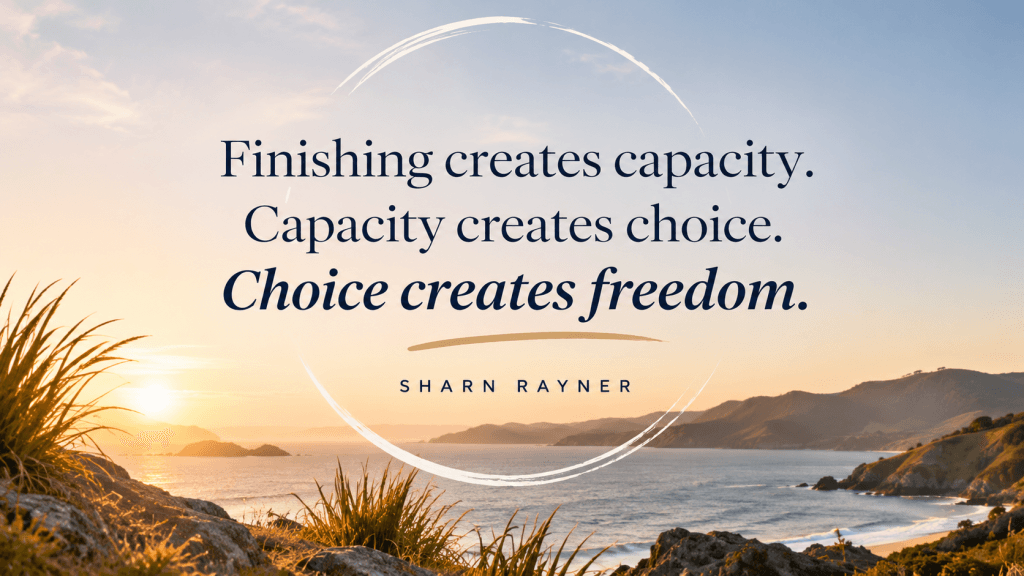
Finishing creates capacity. Capacity creates choice. Choice creates freedom.
As we approach the end of another year, perhaps it’s worth reviewing those amber priorities before planning another ambitious list. Consider what finishing the right things now would make possible for you, your leadership team and your business next year.