
Blog & Resources/

Bingo! Who Knew It Could Be Such a Good Business Strategy?
In short: A members’ bingo card at ANZCAL reminded me how a little fun can get the important, put-off tasks done, because every square was tied to the alliance’s purpose. As a business growth strategist in NZ, my takeaway for leaders is simple: understand what motivates your people, then make the work that matters more engaging to do.
Before moving to New Zealand, Matt and I used to spend our evenings at the Working Men’s Club in England, playing bingo with my grandma and her friends. We were undoubtedly the youngest people in the room, competing for prizes ranging from a box of Quality Street to a bottle of Gordon’s Gin, which was all very classy!
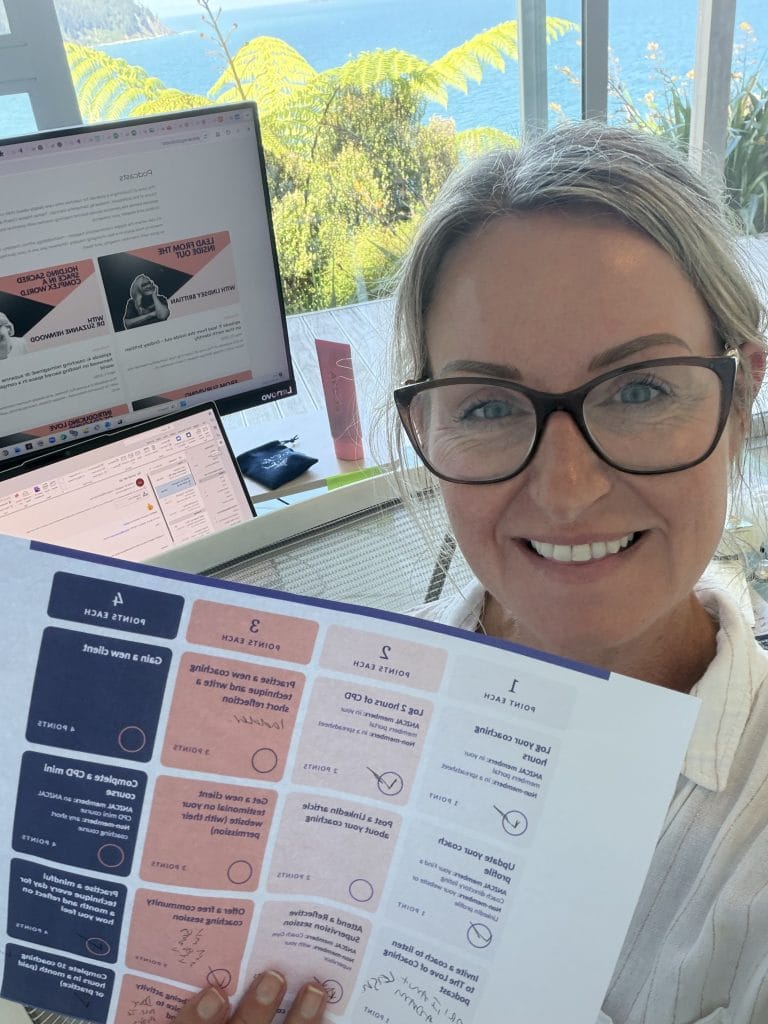
Those evenings remain some of my fondest memories, so when ANZCAL launched a bingo challenge for our members as part of our Love of Coaching month, I couldn’t resist joining in. As Strategic Director, I’m not eligible for prizes, although that did absolutely nothing to dampen my competitive spirit, because give me a challenge, a few boxes to tick and a sense of achievement, and I’m in!
What made this particularly clever was how the activities aligned with our purpose. Members could offer a complimentary community coaching session, request a client testimonial, explore our professional development resources, listen to our podcast or attend a coaching mastermind session.
I found myself doing things I’d been meaning to get around to, including updating my coaching hours and exploring resources I hadn’t previously made time for. Even better, I discovered just how much valuable content we have available, and I was reminded of the extraordinary expertise within our coaching community.
ANZCAL is serious about advancing professional coaching standards through accreditation, development and supervision. That doesn’t mean we need to be serious about everything we do!
It also got me thinking about the wider application for business leaders.
Why not introduce a little bingo?
With the end of the year approaching, many teams are juggling deadlines, compliance requirements and those lingering tasks that never quite make it to the top of the list. Most leaders have a few of their own, alongside the bigger projects we keep putting off, and they tend to feel heavier as the holidays get closer.
Why not create a few challenges that reinforce your strategic priorities, encourage collaboration, recognise progress and make the necessary tasks a little more enjoyable? The ANZCAL card worked because every square pointed back to our purpose, so ticking a box meant moving something that mattered. Your squares can do the same, with each one linked to a priority in your strategy, so the game and the goals pull in the same direction.
Several of the squares, such as the mastermind session and the community coaching session, involved other people, and that was where the expertise around me really showed. A shared card gives your team a reason to work with colleagues they might otherwise pass in the corridor, and to learn what each of them brings.
Part of the fun for me was simply ticking boxes and watching the card fill up, prize or no prize. Teresa Amabile and Steven Kramer’s diary study of knowledge workers, The Power of Small Wins in Harvard Business Review, found that making progress in meaningful work lifted people’s motivation more than anything else, with even small wins counting. Recognising progress as it happens, rather than waiting for the year-end result, keeps the energy up through the busiest weeks of the year.
Updating my hours was hardly the most thrilling job on my list, yet as a bingo square it became one more box to tick, and I did it gladly. The necessary tasks still need doing, so you may as well have some fun with them.
Why would a business growth strategist in NZ recommend bingo?
It’s a simple example of how understanding what motivates people can influence behaviour, strengthen engagement and turn strategic intentions into action. Plenty of good plans stall in the gap between the strategy day and the work that follows it. Research by Donald Sull, Rebecca Homkes and Charles Sull, published by HBR as Why Strategy Execution Unravels, found that two-thirds to three-quarters of large organisations struggle with execution. A lighter touch is often what gets people moving again.
Sometimes, effective leadership isn’t about introducing another complicated initiative. It’s about finding a more engaging way to achieve what matters.
So, what’s on your team’s list right now that a little friendly competition might finally move? Who knows, some Quality Street might be all the incentive you need!