Blog & Resources/

Done Is Better Than Perfect
Done is better than perfect because the work you keep refining helps no one while it sits unfinished. The thing holding most founders back is rarely the quality of the work. It is the fear of being judged once it is out in the world.
“Share what you write, Sharn. Get on LinkedIn, post your frameworks, write the book.” I heard some version of that for years, and every time I gave it a very Kiwi “yeah, nah.”
I was so sure I’d be told to get back in my box, so sure there was a “right” way to do it that I hadn’t earned yet, and I was literally terrified of the trolls. So instead, I poured it into the group of clients I worked with, and I loved seeing them excel. That felt safe. The work was real, the results were real, and no one outside the room ever had to weigh in on any of it.
Eighteen months ago, I started the book anyway, and six months ago, I started posting, slowly and badly, on some weeks. Then people would tell me they’d written a book in twelve weeks, or that they fire off a LinkedIn post in ten minutes, and I’d think, right, okay, cool. Comparison really is the thief of joy.
The work was finished long before I let anyone see it
Here is the part I find hardest to admit. The book was good enough to share a long time before I shared it. What got me over the line in the end wasn’t confidence; it was the advance readers of the book manuscript. Coaches reading it back to me and naming things I couldn’t see, because I was too deep in it to see anything but the flaws. One printed the whole thing out and put it next to her desk. Another rebuilt the pricing of her business off the back of it, and told me so.
Meanwhile, with the learnings of the last eighteen months, I am very conscious of what I would change if I had my time again, while they’re reading the version that already helped them. That gap, between the flaws I can see and the value they are getting, turns out to be the whole story.
Why the people who can ship anyway pull ahead
This is not just my own private hang-up. Research from Harvard Business Review describes exactly the trap I was in. Perfectionists avoid challenges in order to avoid failure, and ruminate on their own weaknesses, and both of those steadily erode performance. The suggested way out is almost insultingly simple. Stop trying to be perfect, and aim to be one per cent better instead.
There is a commercial cost to getting this wrong, too. A separate HBR study of 150 firms found that overwork and the endless polishing that comes with it are rarely a personal failing. They are systemic, baked into the tempo of how we run our businesses. The longer you sit on the thing, the more that culture of never-quite-finished hardens around you. While you perfect it, someone with a rougher version is already in the market, learning from real customers. That is why I treat this as a business growth strategy question, not a confidence one.
What are you sitting on?
Most founders I work with took a real risk to build what they have. Yet there’s often something new they won’t put out, held back by the second-guessing. Is it good enough? Should I just stay as I am? The doubt does the stopping, not the quality of the work.
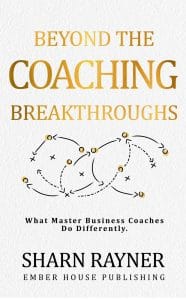
You’ll have your own version of it. The product that’s nearly ready, the offer you keep refining, the idea you’ve talked about for years. The book I almost didn’t publish is called Behind the Coaching Breakthroughs, and it launches on 14 July. I am telling you that not to sell it, but because writing it taught me the thing I now watch for in every founder I sit across from. The cost of holding back is invisible right up until you stop, and then you realise how much was waiting on the other side of finishing.
So, what are you sitting on that could move your business forward? Done might already be good enough, and it might be the thing that takes you forward, or the thing you’re remembered for.