Blog & Resources/

Why the Best Leaders Don’t Land the Fish Alone
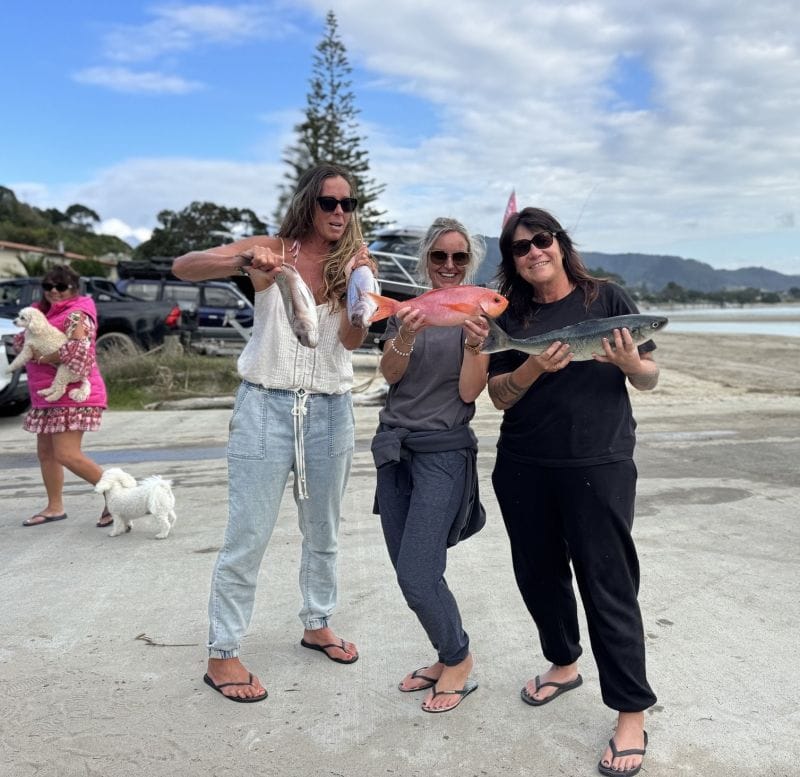
Last weekend, very last minute, I found myself out on the water in Tairua at 6.00am for the Fish n Chicks competition. I had been firmly told by my daughter that I was not welcome on our family boat. We have, it turns out, very different definitions of “cool mum.”
So, I joined a group of friends instead. Aside from a solid bout of seasickness and a rod I had chosen because it was nice and light rather than because it was fit for purpose, it was a good day. Close to 160 female anglers out on the water. Me, battling away for a just-legal snapper and quietly hoping to win the spot prize of a trip to Tahiti.
My daughter, Caity, fishing close to home, landed the biggest snapper of the day. 7.1kg. She had a strategy. She had been reading up on baits, rods, and locations. My strategy, if I am honest, was hope.
The quiet problem in the middle of most growing businesses
I have been thinking about that day all week, because the pattern is one I see sitting across from mid-market CEOs almost every week of the year. You have built something real. Ten staff, fifty staff, a hundred and fifty. $5m, $20m $50m in turnover. You are the reason the business exists. You are also, quietly, the ceiling it keeps bumping into. You are the one who knows where the fish are. You are the one with the history, the client relationships, the commercial instinct, the pattern recognition that took twenty years to build. When something important needs doing, it comes to you. When something goes wrong, it comes to you faster. And somewhere underneath the pride of having built it, there is a fatigue that is harder to name. Because the business is growing, but you are not gaining any room. This is the moment the conversation usually shifts. Not to strategy, not to systems, but to the leader.
What I actually learned on that boat
Here is what I noticed on the water that morning, watching the women I was fishing with. They were significantly more successful than I was. Not because they were gifted anglers, though some of them were. Because they were set up for the day we were actually having. The right rods for the fish we might realistically hook. A clear sense of where to drop the line. A willingness to talk to each other, share what was working, adjust. I learned more in those few hours by watching, asking, and being part of it than I would have learned in a month of reading; and when I was ready to call it a day at 10.00am, green around the gills and thoroughly over it, they propped me up. It wasn’t like I could swim home. So I got stuck in.
The thing I keep coming back to is this. I did not need to be the best angler on the boat. I needed to be on the right boat, with the right people, honest enough to say I was struggling, and open enough to learn from what they were doing. That is the shift, and many mid-market CEOs are one decision away from making it, but the decision is harder than it looks.
The leadership multiplier
The work I do with founders and CEOs has a name for this. I call it the Leadership Multiplier. It is the move from doing to scaling through others. It sounds simple, though I appreciate, it is not. The reason it is hard is not operational, it is psychological. The thing that built the business, your capability, your instinct, your willingness to carry it, is the exact thing you now have to stop relying on. You have to trust that a capable team, well led, will collectively outperform a brilliant individual. You have to accept that the result of letting go will not be perfect. And you have to believe that your job, from here, is not to land the biggest fish yourself. It is to make sure the boat is set up so the people on it can.
Most CEOs nod at this in principle and resist it in practice. Because the moment you stop being the person who does it, you need to become the person who develops, decides, and directs. That is a different skill set and it is often a less immediately gratifying one. For a while, the business will feel slower, not faster. That is the valley almost every growth-stage founder must walk through.
What it looks like when it works
The CEOs who make it out the other side share a handful of things. They stop hiring for execution and start hiring for ownership. They stop measuring their team on activity and start measuring them on outcomes. They stop protecting their people from hard decisions and start expecting them to make hard decisions. They get genuinely curious about why someone on their team is more effective than they are at a particular thing, and they get out of the way.
So, here is the question
Caity won her weight division. I didn’t win the trip to Tahiti. But I came home with something more useful, which is a very clear picture of the difference between being busy on the water and being set up to land something that matters. Mid-market growth is the same. You can keep being the most capable person in every room in your business and you will keep getting a version of the result you have always got. Or you can build a boat, and a crew, that can land fish you could never land on your own.
So, where are you still the one with the rod in your hand when you should be the one setting up the boat? And what would it cost you, really, to put the rod down?
Sources:
- McKinsey on the CEO transition from operator to leader
- Harvard Business Review on scaling through delegation and team effectiveness