
Blog & Resources/

Strategy Is a Recipe
No one has ever called me a good baker. Unless the next thing they wanted to do was laugh.
At secondary school I made chocolate eclairs that looked like dog mess. I burned myself badly enough to need medical attention on an upside-down cake. At the Christmas fete, I confused the curry powder with the cinnamon and sold mince pies that no parent ever forgot. Mrs Hall, my Home Economics teacher, asked me not to continue with cooking for GCSE (the English equivalent of School Cert). When I told her how much I loved it, she gave me a commendation for the year. I took the prize. On reflection, I took the bribe.
Things never improved. The birthday cakes I made for my kids from packets, where the only instruction was add an egg, were still disasters. How, when all I had to do was add an egg?
This weekend a friend gave me a sourdough starter, and I thought: this could be my new thing.
Three attempts, three lessons in disguise
Attempt one was an over-hydrated blob with no flavour. I put the starter in at the wrong stage. I did the steps out of order. Where the recipe didn’t spell something out, I filled in the gap with an assumption that turned out to be wrong. Fold the dough. Right, onto the bench then… No… Not onto the bench.
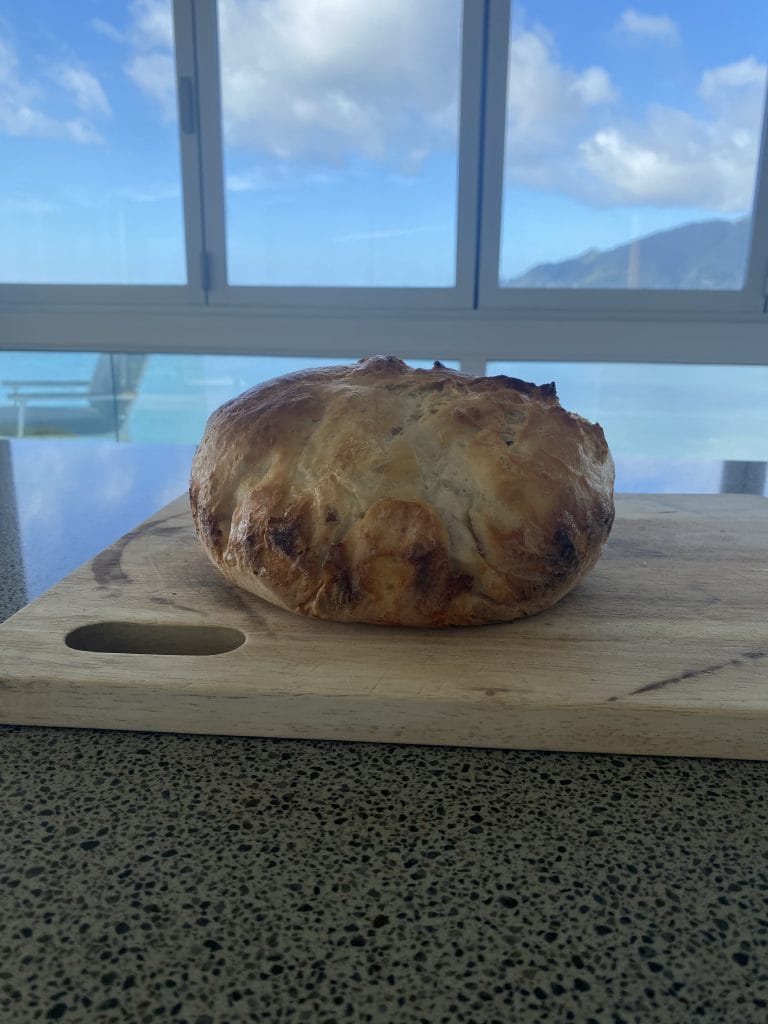
Attempt two had less water, but I forgot a couple of folds because I got distracted halfway through. Still, the crust on that one was something. The kind of crust that makes you think you might actually be onto something.
Attempt three is tomorrow.
What the second loaf showed me
Sitting with the second loaf, I noticed three things about how I have approached baking my whole life.
I have never stayed focused on the one thing in front of me. The phone goes. Someone needs something. I wander off to do the laundry while the dough is meant to be folded. The bread is never the only thing happening in the kitchen, even though, for those few hours, it ought to be.
I tend to wing it. My measurements have been, at best, approximate. A handful of this. A bit more of that. The recipe says 350 grams of flour and I tip in something close enough.
Timings? Either that should do, I’m in a hurry or shoot, I forgot to get the baking out of the oven!
Then I caught myself… oh the irony. Because this is exactly the conversation I have with my clients most weeks. “Focus on the one thing.”
The recipe is not the problem
When we have a strategic plan, our recipe for success, we need to focus on it. It is the one thing. The business does not stop, of course, but we must stay focused on the end goal, the finished baking as it were. If we let the BAU crowd out the strategic work, what comes out doesn’t match the vision in your head, or what was outlined in the plan. It is sloppier, messier and not tasting as good. You know instinctively that you didn’t add the right ingredients, the right people and resources, at the right time. The outcome is underbaked, overbaked, or not even baked.
The leadership teams I work with that consistently move the needle do not have better strategies than the ones that don’t. Most strategic plans are good plans. The off-site was solid. The recipe is fine.
What happens after the off-site is the issue. Back in the business, BAU continues, which it has to, but the strategic activities, the ones with the longest payoff and the most leverage, get displaced by whatever is loudest that week. The team is not lazy. They are not unaligned. They are getting distracted halfway through the fold. Three months in, the plan is not failing. It is just not happening.
That is why I keep coming back to the same question with my clients. Not is the strategy right. The strategy is usually fine. The question is whether you are actually following it, week by week, with enough discipline that the long-term work survives contact with the urgent.
What I am taking into attempt three
Tomorrow I will measure properly. I will stay at the bench. I will do the folds when the timer says, not when it suits me. I will probably still produce a loaf my family eats out of loyalty rather than enthusiasm. But it will be better than the last one, and I will know exactly why, which means attempt four has a real shot.
The point is not the perfect loaf. The point is that I have stopped pretending the recipe was the problem.
Are you actually sticking to your strategic plan, your business recipe? Or are you winging the measurements, getting the timings wrong, mixing up the ingredients, and then wondering why it just doesn’t taste right?