Blog & Resources/

Why Good Enough Quietly Becomes Your Leadership Ceiling
I joined the latest gym challenge here in Tairua a few weeks back. Eight weeks, team-based, points for everything from training sessions to bench press PBs. I love a challenge, I love being challenged, and I signed up before I’d thought too hard about it, which is usually the right way.
The challenge starts with a body scan. Mine came back optimal in every category, with a bio age four years below my actual age. Not bad for 50.
Here’s the thing about body scans, though. The ranges are wide. The gap between optimal and poor can be a 1% shift, which means you can sit comfortably inside optimal and still be drifting in the wrong direction. The single scan won’t tell you, because it only shows where you are right now, against a fairly forgiving line.
So I pulled my last eight scans, going back a couple of years, and ran them through an AI tool. I wanted the trend, not the snapshot. The commentary was brutal:
“Sharn, this is the classic pattern of body recomposition going the wrong way in midlife: losing muscle, gaining fat, while weight stays roughly stable. It’s exactly what happens to post-menopausal women who aren’t training hard enough to offset muscle loss, and it’s invisible on the scale.”
Wow. Yet, accurate, honest and fair.
The pattern that’s invisible on the scale
That description of me is also, almost word for word, what happens to a lot of leaders who have been running their businesses for ten years or more.
Revenue, margin, and team shape are all roughly the same as last year and the year before; slight gains, even, and nothing in the board pack is screaming ‘failure’. Underneath, though, capability is leaking. Your senior team is a little less sharp than it used to be. Decisions take a little longer. You don’t challenge in quite the same way. You are comfortable. None of it shows up on the scale because the scale isn’t measuring what’s actually changing. By the time it does show up, you are not dealing with a one per cent drift; you are dealing with two years of one per cent drifts, compounded, and then you are the underperformer in the industry, stagnant, stale, irrelevant. Good enough becomes the ceiling, not because you chose it, but because nothing made you look past it.
This is not a hypothesis I made up between weight sessions. Harvard Business Review research into senior team dysfunction names this exact pattern as one of the three most common ways leadership teams fail. They call it “the mediocracy” — the team that is comfortable, focused on past success, and quietly stops competing at the level it used to. The board doesn’t see it. The P&L doesn’t see it. The team itself doesn’t always see it. But the trend, if you ran one, would be unmistakable. You can read the full piece here.
The scale of the issue is bigger than most CEOs realise. PwC’s 27th Annual Global CEO Survey, reported in HBR, found that 45% of CEOs do not believe their companies would survive more than a decade on their current path. Nearly half. These are not businesses in obvious trouble. They are businesses where the snapshot looks fine and the trend says otherwise.
Why optimal is the trap
My instinct, looking at that first scan, was to be pleased. Optimal, bio age below actual, nothing to worry about. I could have easily stayed in that space comfortably for another year. The only reason I didn’t is that I’d signed up to a challenge that needed me to actually move the numbers, which meant I had a reason to look harder. Plus I love a challenge and to be challenged.
Most established CEOs do not have that mechanism. The business is doing well enough, the team is performing well enough, there’s no burning platform forcing the conversation, so the conversation doesn’t happen. The single scan keeps coming back optimal. Nobody is asking what the trend looks like, because nobody is looking at the trend.
This is where good strategic coaching for CEOs earns its keep. Not crisis intervention. Not turnaround work. The unglamorous, quietly compounding work of refusing to let optimal be the answer when optimal is one per cent away from poor. A coach is, functionally, the eight-scan trend. The thing that won’t let you settle for the snapshot.
What I’m actually doing about it
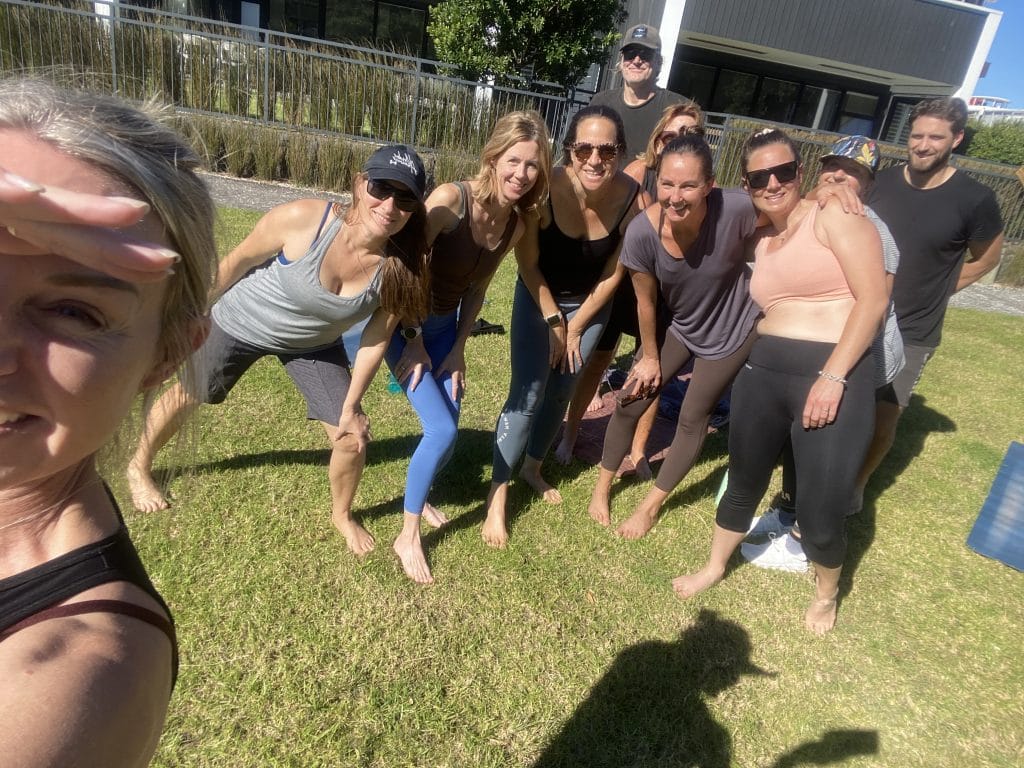
I’m now at the gym at 5 am with my seventeen-year-old daughter, Caity, lifting weights. Three weeks in, sore in places I forgot existed and enjoying the buzz of the team banter and fierce competition. My team is sitting at the top of the leaderboard for the third week running. I’ve been in the top three Masters Women for the bench press and the wall sit for two weeks running, which I did not see coming.
None of that would have happened if I’d taken the first scan as the answer and stopped looking.
The diagnostic
Three questions worth asking yourself this week.
- What’s currently making you look at the trend in your business, not just the snapshot? If the honest answer is nothing, the muscles you need to flex aren’t the ones in the gym.
- Where are you calling something “fine” that, if you ran the eight-scan trend on it, would actually show drift?
Most leaders know the answer to that second one. They just haven’t said it out loud.