Blog & Resources/

What Preparation Taught Me About Leadership Coaching NZ
Many years of running workshops puts me firmly in the comfort zone with this skill set. The mahi still goes in, each one researched, designed, sequenced, and focused on taking my clients further toward their goals. But a workshop is a conversation. People talk back. They bounce ideas, concepts, thoughts; you read the energy and follow it.
A talk is a different thing.
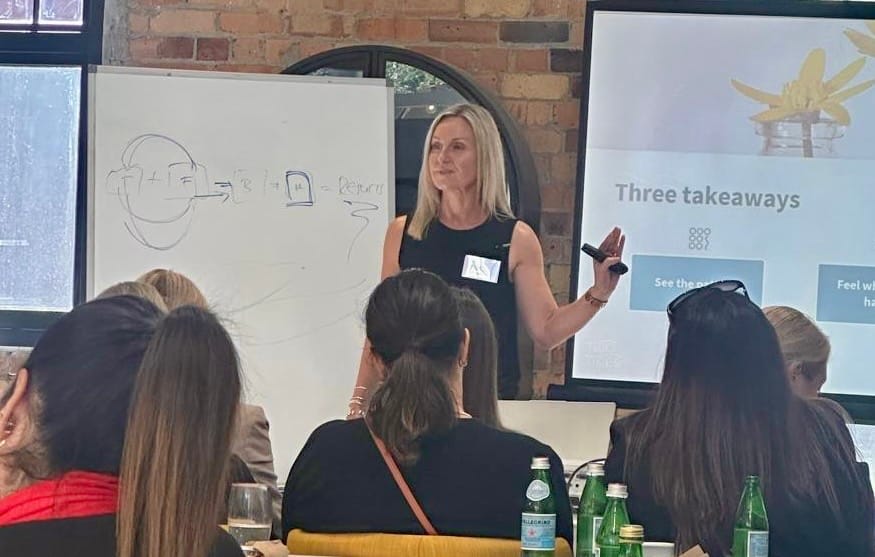
After being part of our Women in Leadership series, Bridgette Johnstone, Co-Founder of Recruitment Studio, asked me to give a 35-minute talk to HR, OD leaders, and CEOs in Auckland. I said yes immediately. Absolutely! The desire was there. The discomfort came later, when I remembered that a talk is a talk. There is no conversation to lean on. You stand there with whatever you brought.
Even though I know my subject, with the caveat that I am on a permanent journey of learning more, I spent three to four weeks drafting and rebuilding. Running the structure through my NLP lens to check what the language was doing to the listener. Walking it through out loud, hearing where the rhythm broke. By Thursday, I felt excited for the Power Lunch, where I would be talking about what actually changes leadership performance for the better.
I still got things wrong. A step missed here, a moment that could have landed harder there. Thankfully, the room didn’t seem to notice, and the feedback was generous. But I have my own feedback, gathered in rehearsals with the dog, and there is more to do. Feedback, not failure.
Pushing myself outside my comfort zone is exactly the space I hold for my clients.
The mid-market CEO comfort zone is not where you think
Most of the CEOs I work with have built their businesses from small to somewhere between 10 and 200 staff, $5-50 million in turnover, and they got there by being the closer, the strategist, the one who could hold the numbers in their head, the one who knew every client by name, the one who made the calls. That work built the business, and it is now also the trap.
The mid-market CEO comfort zone is not the workshop they’ve run a dozen times or the meeting where they are the deepest expert, because they are well past that. The comfort zone is more specific and harder to see. It is still them personally closing the top three accounts because they are the strongest closer, instead of building a commercial leader who can. It is still running the weekly numbers review because they have the sharpest fluency with the financials, instead of trusting the CFO they’ve put in place. They’re still making the final call on senior hires three levels down because they have the best instinct for fit, and they’re still carrying the strategic thinking themselves because no one else in the business yet thinks at that altitude.
None of this is laziness, and none of it is easy work; it is the work they have become brilliant at, which is precisely the point. The behaviours that took the business from one million to twenty million are not the behaviours that will take it from twenty to fifty, or from fifty to sale, and familiar is what comfort looks like at this level. Not idleness. Mastery of the part of the role that no longer stretches the leader and, more importantly, no longer stretches the business.
This is the trap Harvard Business Review has been calling executive presence backfire, where the instincts that got someone promoted, having the answers, projecting confidence, jumping in to improve ideas, become the very instincts that undermine them at the top. The mid-market founder-CEO version is sharper still, because they didn’t just get promoted into these behaviours; they built a company on them, and letting them go feels less like growth and more like betraying the thing that worked.
What separates the ones who keep growing
What separates the ones who keep growing, the ones whose businesses have grown net profit by a median of 189%* across coaching engagements of three years or more, in a country where the average business grows operating surplus by about 5% a year, is that they constantly want to do the next thing that challenges them and challenges their teams. They are not content with mediocrity, and they live in the growth zone, accepting feedback when things don’t go to plan, happy to dust themselves off and try again the next day, until the learning means they create new habits, become masters of new skills and experiences, and that becomes their new dominant behaviour. A must for high performers.
McKinsey’s research on excellent CEOs, based on data from 7,800 CEOs across 70 countries, makes the same point from a different angle. The truly distinctive leaders share a learning agenda they protect with the same discipline they apply to strategy, and Satya Nadella, the example McKinsey returns to, blocks one day a month for nothing but learning. The CEOs who stall are usually the ones who have stopped asking what they need to learn next.
ACME, and what it actually costs to move through it
The framework I walked the Power Lunch room through is called ACME. It is Gina Mollicone-Long’s work from her book Think or Sink, and I use it because it honestly describes the journey.
A is the comfort zone, the ceiling you have already hit. B is desire, wanting something different enough to leave A. C is trial and error, the phase where you are visibly not good yet, and the phase most people quit. M is mastery, not the end of effort, but the point at which the new behaviour becomes the dominant one.
The reason I am writing about this rather than just teaching it is that I had to walk through C myself to give the talk. The version of me sitting at the kitchen table in Tairua at draft twelve, knowing the structure still wasn’t right, is not the version that shows up in the photos afterwards. That is where the work happened, and that is the part most people don’t see.
To be honest, I dreaded it. If another speaking opportunity comes along this year, I will say yes, and I will dread that one too. The dread isn’t a signal to stop. The dread is the signal that the work is in the right place.
The question for you
- If you are running a business and you have been doing it well for a long time, the question is not whether you are working hard, because you are.
- Which parts of your job did you build the company on, and which of those is now the thing holding it back?
That second category is usually where the next bit of growth is hiding.
If this lands, the next step is a conversation.
*Median net profit growth across Two Tides clients engaged for three years or more. NZ benchmark: 4.9% annual operating surplus growth, Stats NZ Annual Enterprise Survey 2024.